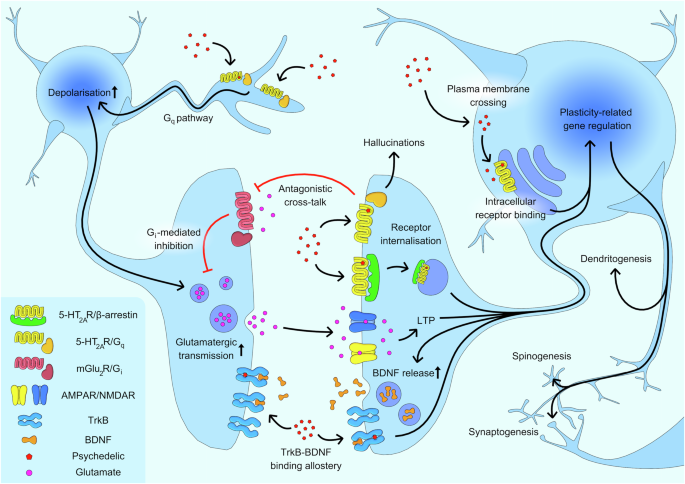
Psychedelic substances have garnered renewed scientific interest due to their potential therapeutic effects, particularly in treating depression and other mental health disorders. Central to these effects is the 5-HT2A receptor, a subtype of serotonin receptor that plays a crucial role in modulating neuroplasticity—the brain's ability to reorganize and form new neural connections.
Research indicates that activation of the 5-HT2A receptor by psychedelics such as psilocybin and LSD triggers a cascade of cellular and molecular events that promote neuroplasticity. These events include increased expression of brain-derived neurotrophic factor (BDNF), synaptogenesis, and dendritic growth, which collectively contribute to the rewiring of neural circuits associated with mood regulation and cognition.
Understanding the precise mechanisms by which the 5-HT2A receptor influences neuroplasticity has significant implications for developing novel antidepressant therapies. Unlike traditional antidepressants that often take weeks to exert effects, psychedelics can induce rapid and sustained improvements in depressive symptoms, largely through their action on this receptor.
Preclinical studies have demonstrated that the activation of 5-HT2A receptors enhances neural connectivity in key brain regions such as the prefrontal cortex, hippocampus, and amygdala. These areas are critically involved in emotional processing and stress regulation. The receptor's activation leads to increased excitability and plasticity of neurons, facilitating the formation of new synaptic connections that underpin behavioral and mood improvements.
Furthermore, clinical trials have shown promising results, with patients experiencing significant reductions in depressive symptoms following psychedelic-assisted therapy. These effects are believed to be mediated through the receptor's role in promoting neuroplasticity, which allows the brain to recover from maladaptive patterns associated with depression.
Despite these promising findings, challenges remain in translating this knowledge into widespread clinical practice. Issues such as dosage, safety, and long-term effects need further investigation. Nonetheless, the ongoing research underscores the potential of targeting the 5-HT2A receptor as a novel approach to mental health treatment, harnessing the brain's innate capacity for change and recovery.